Phishing Defense Handbook
Learn how to spot and stop phishing emails and online scams.
$10.00
Pay Now with Square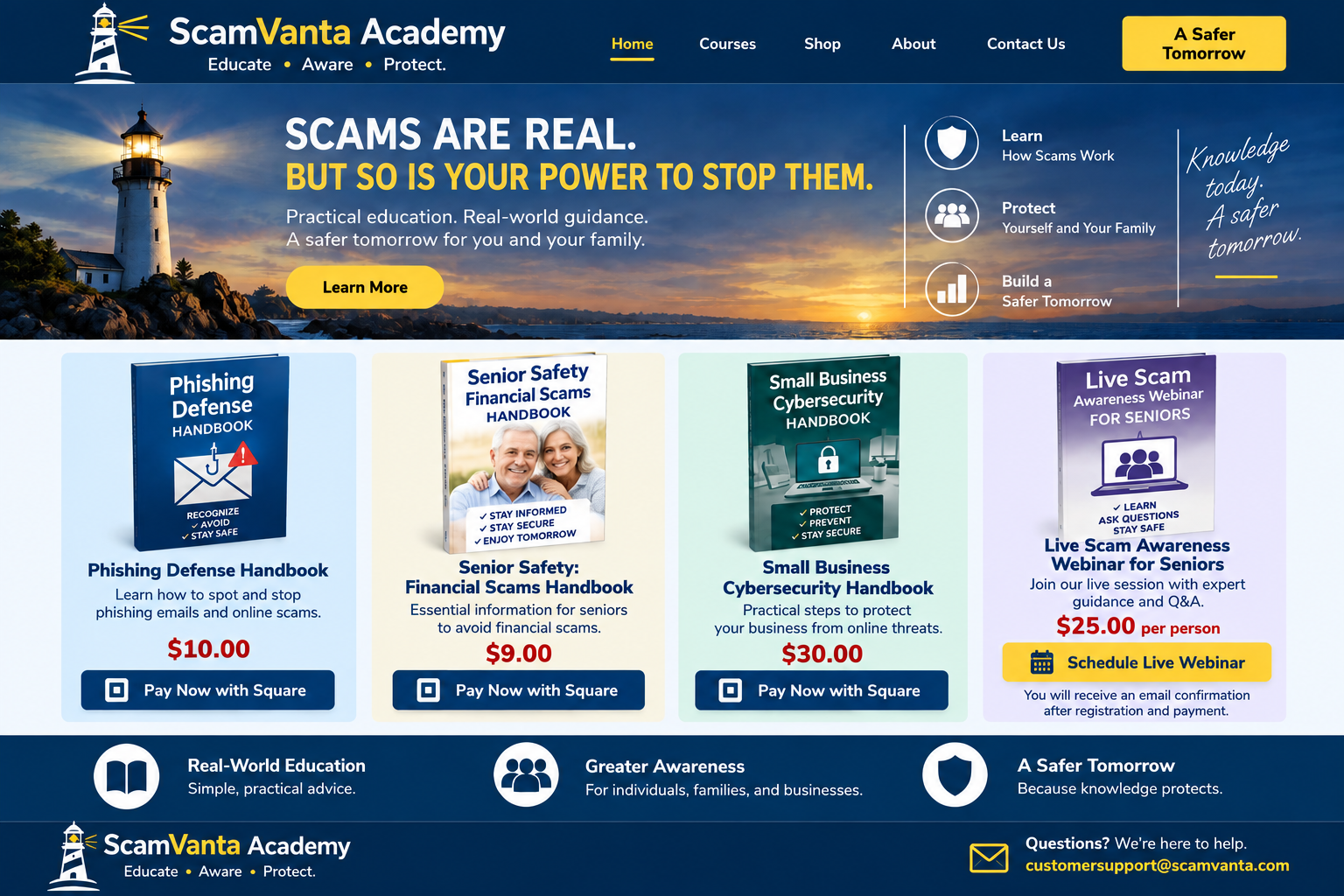
Practical education. Real-world guidance. A safer tomorrow for you and your family.
Learn MoreLearn how to spot and stop phishing emails and online scams.
Essential information for seniors to avoid financial scams.
Practical steps to protect your business from online threats.
Join our live session with expert guidance and Q&A.
You will receive an email confirmation after registration and payment.
After more than 30 years of professional experience, including over 25 years working for one of the world’s leading technology companies in the USA, I saw how rapidly technology was changing—and how scammers were becoming increasingly sophisticated.
Stories of successful, well-known individuals and professional athletes falling victim to financial scams reinforced an important truth: anyone can be targeted.
That realization inspired me to create ScamVanta Academy—to share practical knowledge that helps individuals, families, seniors, and businesses recognize warning signs, protect their financial information, and make safer decisions in an increasingly digital world.
Our purpose is simple: Educate • Aware • Protect.
Scams can take savings built over a lifetime. Learning the warning signs helps you pause, verify unexpected requests, and protect your money.
Fraud losses reported by consumers to the FTC in 2025.
Fraud losses reported by adults 60 and older in 2024.
Reported losses among adults 60 and older grew from about $600 million in 2020 to $2.4 billion in 2024.
Median reported loss among adults 80 and older in 2024, when money was lost.
These figures describe reported losses, not every scam or the full cost of fraud. The overall total uses 2025 data; the older-adult figures use the FTC’s 2024–2025 older-consumer report and describe 2024. The figures are from different years and should not be compared as shares of the same total.
Older adults reported higher typical losses than younger adults. Tech-support, prize and lottery, romance, and government-impersonation scams were particular risks.
Official sources: FTC 2025 fraud-loss figures · FTC older-adult findings.